Showing posts with label ramblings. Show all posts

Friday, November 6, 2015

There are tons of websites to find a job, that's the thruth


There are tons of websites to find a job, that's the thruth

So? There has been a long time since my last post, I've been starting so many projects including some business and stuff and today I'm back to write about this topic which is not even close about the last posts.

So if you are looking for some networking or computing cheat, that's not your post :)

I'm here to think and write about job hunting websites and all about those things.

There was an age...


There was an age where sites like linkedin and infojobs were cool sites to find a job, but, to be honest the have lost that charming brand new magic and they are just a huge curriculum store.

And now what? what's the trend?

That's the point, there are no reference in this matter, it becomes a problem when you are trying to upload your CV to the Internet because you need to keep up-to-date from three to ten profiles in different websites which are roughly the same thing.

There are no fashion sites, the trend now is that there is no trend; and that's a real problem.


I've no tips about which site is the best, so that's my idea, create your own.
Maybe it looks a bit crazy, but it's just an idea.

My own site? What kind shit is that?

Ha ha! You may be right, it could be crappy if you do by the wrong way and the problem is... that there is no best-way but I think that this may be a good chance to take the attention about a head hunter / human resources crew if you make the difference by sending your CV just all-in-one by sending a URL.


Some examples?

I've no examples but I have some ideas to tell to you:

- Create a easy-quick-free site using services like blogger. This is easy to do and free, the only problem may be the low customization level.
            www.blogger.com

- Contact with cheap webhosting services like 1and1 "my web" or something like this, they are intended for small business but you can try it. They have medium customization level.
           www.1and1.com

- You can try too by contacting the MiniWeb guys, they are a brand new website design&hosting company, they just started a few months ago but they are doing quite well. You can contact them both in English or Spanish, you'll find a very cheap service packs. Can contact by facebook, twitter or send a message from the web form contact.
          www.miniwebspain.tk


We are legion

Friday, January 23, 2015

Mis distribuciones favoritas de Linux. Auditoria WiFi

Hola de nuevo

Hacía ya mucho tiempo del último post, muchos cambios en mi vida ultimamente pero estoy de vuelta :)

Hoy estamos aqui para hablar de las ultimas distribuciones live pensadas para auditoria inalámbrica.

Ha habido muchos cambios en este tiempo, muchos linux con muchas herramientas de auditoria wireless que ya vienen instalados y que se ejecutan live, sin necesidad de instalar linux en nuestro PC, persistentes (igual que live, pero que además te almacenan datos de una ejecución para otra) o si lo deseas instalandolo tradicionalmente; hoy hablaré de mis favoritas.

  • Xiaopan OS (pequeña y manejable)
  • WifiWay / WifiSlax (en realidad son la misma)
  • Kali (bestial, potente, enorme)

La peque, Xiaopan OS

Xiaopan Logo

Se descarga en inglés de http://sourceforge.net/projects/xiaopanos/   unos 70 Mb, tenies aqui toda la información en su web http://xiaopan.co/


De su sitio web leemos (traducción):

Xiaopan OS es una distribución  con una colección de herramientas forenses de penetración y seguridad inalmbricas, muy fácil de usar. Incluye herramientas avanzadas para administradores de red, profesionales de la seguridad y usuarios domesticos para probar la resistencia a ser pirateadas de sus propias wifis, con el objetivo de eliminar cualquier vulnerabilidad.
Xiaopan (0.4.7.2, última versión a dia de hoy)

Hice tres pruebas:
La primera, con mi PC de escritorio, funcionó genial ejecutandose live desde un USB, probé diferentes herramientas y opciones, todo perfecto. Distribución pequeña pero poderosa.
El segundo intento con un portatil, no fue capaz de detectar mi tarjeta de red, hice un montón de pruebas y probé muchas "soluciones" de foro de Xiaopan, no hubo forma.
Último intento: Con un mini-portatil de mi novia, igual que el anterior, no hubo forma.

Por tanto, puedo concluir que Xiaopan es una distribución muy pequeñita con un monton de opciones y utilidades pero necesita un pack mayor de controladores y drivers, sobre todo para tarjetas de red, ya que es su objetivo principal. Será una gran distribución linux para auditoria si sigue evolucionando en un futuro cercano. Eso espero.


WifiWay / WifiSlax

Esta es una distribución linux impresionante, me encanta, tiene un equilibrio perfecto entre el tamaño de la distribución y la cantidad de cosas que permite hacer.
Me encanta porque es lo suficientemente pequeña como para ser almacenada en un USB de estos baratos que puede haber por casa pero la cantidad de drivers y utilidades que tiene es impresionante, seguramente será una de las mejores y más completas distribuciones para auditoria wifi.

WifiSlax Logo

Podriamos llamarlas las distribuciones gemelas, podeis probar las dos, son bastante parecidas pero de vez en cuando va saliendo una versión de cada una de ellas, yo las utilizo indistintamente.


Se pueden descargar de http://www.wifislax.com/category/download/nuevas-versiones/
Además su pagina web tiene un montón de tutoriales y manuales en Español, muy bien explicados. Todos ellos además con imagenes y videos para que sea todo incluso aun mas facil, encontrareis todo lo que podais necesitar y aun mas.

Ambos linux funcionan genial tanto live como de forma persistente (evidentemente instalandolo tambien, incluso mejor, aunque no es necesario). Siempre suelo ir probando distribuciones de auditoria para ir viendo lo que ofrecen, pero cuando tengo que hacer algo serio voy directamente a estas, nunca dan problemas, funcionan, haces lo que necesitas y lo apagas, asi de facil.


Kali

Es, (según su propia web) el renacimiento del archiconocido BackTrack, si sabes del tema no necesitaras mas presentaciones.
BackTrack era el mejor y mas conocido linux para auditoria de seguidad (no solo wifi, de todo tipo) en el mundo, todo el mundo lo adora, por tanto, todos deberian estar encantados también con Kali.

Digo esto porque hay algunos cambios en su forma de funcionar (la inmensa mayoria son mejoras, claro) pero seguro que algún nostalgico del backtrack hecha en falta algun detalle.


Kali Logo
Descargate Kali de aqui https://www.kali.org/downloads/


 Hay un montón de versiones de  Kalis, para 32 bit, 64 bit, para ARMEL chips, para ARMHF chips... incluso tienes la opcion de bajarte un core de linux donde tu puedas irte personalizando tu propia versión de Kali, todo muy geek.


Resumiendo, es un linux enorme si hablamos de herramientas, funciones, utilidades...tiene mucho mas de lo que podrias aprender a utilizar en siete vidas, pero en mi opinión tiene demasiadas cosas para poderlo llevar en el tipico USB barato. Quiero decir, funciona estupendamente tanto live, instalado.... todo bien, pero es algo pesado.


Me suele gustar hacer una especie de resumen grafico de cada post para que todos podamos ver de un vistazo la idea general de estas distribuciones:

WifiSlax

Xiaopan
Kali


Xiaopan, te sentirás como Bart Simpson
WifiSlax, rápido y efectivo, sin chorradas.
Kali, enorme, poderoso, pontente, brutal.

En próximos post hablaremos de como hacerte un USB arrancable con linux, la cosa es actualmente mucho mas facil que antaño.


Somos legión.

Tuesday, January 20, 2015

My preferred linux distros. Wireless auditory

Hello there,

Long time ago from my last post, there were too many changes in my life but finally I'm back :)

Today we are here to discuss about current linux live distros for wireless auditory.

There were many changes during this while, lots of linux flavours with many wireless audit tools already installed and ready to run live, persistent or installed on your hard disks but today I will write for my favourites.

  • Xiaopan OS (the tiny one)
  • WifiWay / WifiSlax (actually, the same)
  • Kali (huge, a beast)

The tiny one, Xiaopan OS

Xiaopan Logo

You can download the ISO file from http://sourceforge.net/projects/xiaopanos/   just ~70 Mb and all the info about it at http://xiaopan.co/


From it's own website we get this comments:

Xiaopan OS is an easy to use security and penetration testing with a collection of wireless security and forensics tools. It includes a number of advanced tools for network administrators, security professionals and home users to test the strength of their wireless networks and eliminate any vulnerabilities.
Xiaopan (0.4.7.2 is the latest)

I've tested this distro three times:
The first one: my desktop computer, It worked great live from my USB device, I tested many tools and opcions, all working fine. It's tiny but powerful.
The second one with my laptop, it was unable to detect my wireless network interface, testing tons of "solutions" from the Xiaopan forums, end of story :(
The last one: With my girlfriend's notebook, same as the previous one, wireless interface not detected.

So, my conclusion is that Xiaopan is a very light linux distribution full of options and utilities but it needs a few more controllers and drivers to be widely compatible to many computers and devices. It will be great in the near future, I hope.


WifiWay / WifiSlax

These are awesome linux distributions that I love, it's light enough to be stored in a cheap USB device but has drivers, utilities....  enough to be a great penetration testing linux distribution.

WifiSlax Logo


We can call them the twin distributions, you can test both of them, they are likely the same but from time to time one of them releases a new version, so, I switch between them properly.

You can download it from http://www.wifislax.com/category/download/nuevas-versiones/
Its website has many tutorials and news it Spanish but you'll be able to translate it with no problem, all of them are plenty of photos and videos where you can find all then info you may need.

Both distributions will work great both live or persistent (obviously installed too). I used to test many linux distributions but I'm always  back to WifiSlax when I need to do something important, with no problems, no issues, just working quick and fine.


Kali

It's, (said by their own website) the rebirth of BackTrack, if you know, that's the only presentation that it needs.
BackTrack was the best well-known penetration testing linux distribution in the world, everybody loved it; and now, everybody should love Kali too.

I say that because there are a few changes in the way it works (most of them have improved it) but there are many nostalgic people who misses backtrack.


Kali Logo
You can download Kali here https://www.kali.org/downloads/


 There are many Kali versions, for 32 bit, 64 bit, for ARMEL chips, for ARMHF chips... eventualy you have the chance to download the core and build a custom version for your own.


In summary, it's a huge linux looking at the tools, functions, utilities... it has all you will need for seven lifes! But, it's (from my point) too big for live USB. I mean, it works live from USB but it's not as responsive and quick like WifiSlax


I always love to summarize with images to make things easier to think, that's my view of these distros:

WifiSlax

Xiaopan
Kali


Xiaopan, you'll feel like Bart Simpson
WifiSlax, quick and effective.
Kali, huge and powerful.

In the next post I will write about how to make your own linux USB bootable.

We are legion


Saturday, May 12, 2012

Windows 8 bloqueará programas de terceros


Hola a todos,

Hace poco tiempo leiamos en los foros de Mozilla:
"an unwelcome return to the digital dark ages where users and developers didn’t have browser choices."Said by Harvey Anderson, general counsel in Mozilla co.

Refiriendose al problema que significaría el que Microsoft no permita otros exploradores de internet que no sea el de "la casa".

¿Podeis imaginar un futuro sin programas no-microsoft? No podriamos usar Firefox, Chrome, WinZip, WinRar, WinAmp...


Un poco de arte callejero:


Some people could think "who will buy a OS which will not allow me to decide which internet browser I want?"
La gente podria pensar "¿Que va a comprar un Sistema Operativo que no me va a permitir que explorador de Internet quiero usar?"

Habrá quien llegue más alla: "¿Quien coño va a comprar eso?"

Aqui mi propia opinion: "Ni Dios!!!!!!!"

¿Cual creemos que es la explicación para este comportamiento?

Otra facil de responder!  :)
Es el tipo de action emprendida por una compañía que ha perdido el Norte.

Realmente, ¿alguien cree que esto ayudará a la empresa? Lo que pensamos realmente es que esto va a ayudar a la gente  a plantearse si poner un sistema Unix/Linux en su casa. No?

Si eres uno de esos usuarios, te vamos a recomendar Ubuntu e incluso BackTrack (si eres un atrevido, jejeje) 


Despues de esto seguro que esta imagen adquiere significado para ti.


Se que este es un post más corto que los demas, pero estoy convencido de que NECESITABA informar de esto.


Next post: "My preferred linux distros. Wireless auditory" (English)
Siguiente post: "Mis distribuciones favoritas de Linux. Auditoria WiFi" (Español)

Somos legión!!!

Windows 8 will not allow SW non-MS SW

Hello all,

A few days ago we read at the Mozilla forums:
"an unwelcome return to the digital dark ages where users and developers didn’t have browser choices."Said by Harvey Anderson, general counsel in Mozilla co.

Do you have to imagine a future only with MS apps? You won't be able to use Firefox, Chrome, WinZip, WinRar, WinAmp...


Some art in the street:


Some people could think "who will buy a OS which will not allow me to decide which internet browser I want?"

Even: Who the hell is going to buy that?

My own opinion: "Nobody!!!!!!!"


Which could be the explanation for this behavior?

Easy to answer too :) It is the kind of action undertaken by a company that has lost its way.

Really, does anybody think that this action will help them? I really think that this action will definitely push people to try Linux/Unix at home, don't you know?

If you are one of those users, I will recomend you Ubuntu or even BackTrack :)

Thus, this image will take sense, right? :)


I know that is a very short post, but.... I HAVE TO inform of this, I think is absolutely needed.


Next post: "My preferred linux distros. Wireless auditory" (English)
Siguiente post: "Mis distribuciones favoritas de Linux. Auditoria WiFi" (Español)


We are legion

Sunday, April 22, 2012

#OpBlackout, desconectando internet (Spanish)

(Puedes acceder desde aqui a la versión en Ingles de este post | You can read this post in English here)

Hola!

Espero que os haya ido bien desde el último post.

¿Sabeis lo que es la operación #OpBlackout?

En relación con el título del post, esto podría significar "el cierre de la Internet", pero el título no es fiable al 100%.
Vamos paso a paso.

¿Qué es una dirección IP?

De una manera fácil, es la placa de matrícula de tu PC. La única cosa que tienes que saber es que podrias compartir tu matrícula con otros usuarios si estás compartiendo un router (por ejemplo, el router ADSL en casa o en una oficina)

¿Qué es un servidor DNS?

De manera breve, un servidor DNS es un traductor de direcciones en Internet.
Cuando se escribe en el navegador de Internet "www.mipagina.com", el PC no se sabe qué es eso, porque el ordenador sólo entiende las direcciones IP.

Entonces, el DNS le ayudará a su PC durante la traducción:
www.mipagina.com ====> 12.34.56.78


¿Cómo funcionan los servidores DNS?

Hay sólo unos pocos servidores principales de DNS, los servidores DNS están funcionando sólo intercambiando los datos de otros servidorer DNS.
Este es un trabajo distribuido que mejorará la calidad/velocidad de traducción DNS.


Entonces, ¿cómo puede Anonymous apagar el internet?

Anonymous """""solamente?""""" tiene que bloquear o tirar los servidores raíz de DNS y los otros caeran en un efecto dominó.

Haga clic aquí para obtener más información acerca de servidores DNS raíz.

¿Por qué decimos """""solamente?"""""?

Hay muchas razones técnicas que convierte a este ataque en algo muy difícil o incluso imposible.
La razón principal es que estos servidores DNS principales se implementan como clusters a través de unicast pero no vamos a explicar esto porque este blog sólo explica los temas de hacking sencillos y básicos.

Next post: "Windows 8 will not allow SW non-MS SW" (English)
Siguiente post: "Windows 8 bloqueará programas de terceros" (Spanish)

Somos legión

Wednesday, April 18, 2012

Shutting down the Internet #OpBlackout

(Now you can access to the Spanish version of this post | Ya puedes leer la versión en Español de este post)

Hi there,
Hope you are doing well.

Does someone know what is the Operation Blackout?
Referring to the post title, this could mean "shutting down the internet" but the title is not 100% accurate.


We will proceed step by step.


What is a IP address?

In a easy way, is the registration plate of your PC. The only thing you should know is that you will share your registration plate with other users if you are sharing a router (like the ADSL router in your home)


What is a DNS Server?

In a short manner, a DNS Server is a address translator on the Internet.
When you type in your internet browser "www.mywebpage.com", your PC won't know what's that because
your PC only knows about IP addresses.

Then, the DNS will help your PC when translating:
www.mywebpage.com  ====>  12.34.56.78


How DNS Servers work?

There are only a few main dns servers, other DNS servers are working just by getting data from another DNS servers.
This is a distributed work which will improve the DNS translation performance.


Then, how can Anonymous shut down the internet?

Anonymous """""only?""""" need to bring down those root DNS servers and other will bring down in a domino effect.

Click here to get more information about root DNS Servers.

Why we say "only"?

There are many technical reasons that turns this attack very hard or even impossible.
The main reason is that these main DNS servers are implemented as clusters using Unycast but we won't explain this because this blog only explains the easy and basic hacking issues.

Next post: "Windows 8 will not allow SW non-MS SW" (English)
Siguiente post: "Windows 8 bloqueará programas de terceros" (Spanish)

We are legion

Sunday, April 15, 2012

CISPA (La nueva versión de SOPA)


!Hola a todos!

¿Vives en EE.UU.?


Si es así, tengo malas noticias para ti. Durante este mes un nuevo proyecto de ley está siendo preparado y se llamará "CISPA" ( Cyber Intelligence Sharing and Protection Act )

Puede obtener información oficial sobre la HR3523 aquí. También conocida como el proyecto de ley de Rogers-Ruppersberger.
Estoy muy preocupado por este nuevo proyecto de ley y espero que no seconvierta en ley en los EE.UU.

Mucha gente está escribiendo información acerca de este nuevo proyecto de ley lo que hasta donde yo sé, significará el regreso de SOPA, PIPA y ACTA juntas. Este proyecto de ley se quiere mostrar "distinto a SOPA", pero tiene un montón de temas similares. Por cierto, este nuevo look del proyecto SOPA+ACTA+PIPA ya ha recogido muchos seguidores entre ellos uno muy famoso, Facebook, que es el principal apoyo.

Hay muchos puntos de este proyecto de ley donde no es muy clara, pero explica que los ISPs serán capaces de interceptar comunicaciones privadas para enviar a la NSA (National Security Agency) y DOD's Cibercommand. .

La parte más peligrosa de este proyecto de ley es que algunas empresas serían capaces de espiar y controlar las conexiones de los usuarios sin necesidad de notificar esa actividad a que el usuario o el Gobierno. Por lo tanto, mucha gente piensa que este proyecto de ley se convertiría en una ley que permite el espionaje industrial.

Empresas como AT & T, IBM, Oracle, Symantec, Microsoft, EMC ... apoyarán CISPAdebido a que sus responsabilidades se reducirán en caso de problemas con la ley.

Incluso las empresas como Google o Facebook podían interceptar correos electrónicos y compartir entre ellos y el gobierno.

¿Quieres investigar más a fondo? Sigue este enlace


Realmente, esta es una mala ley, como SOPA y CISPA o, peor aún, y parece que va a pasar sin que la gente hable.

Si no estás en EE.UU. debes estar muy preocupado (como yo) porque la mayor parte de las leyes de EE.UU. se acaban "exportando" a otros países como España, Reino Unido, Alemania, Francia ...

Somos legión.


Siguiente Post"#OpBlackout, shutting down the internet" (Ingles)
Siguiente Post"#OpBlackout, desconecando internet" (Español)

Friday, April 13, 2012

CISPA (the new version of SOPA)

(Now you can read this post in Spanish | Ahora puedes acceder a la versión en Español de este post)

Hi all!

Are you living at the US?

If so, I have bad news for you. During this month a new bill is being prepared and it will be called "CISPA" (Cyber Intelligence Sharing and Protection Act)

You can get some official information about the HR3523 here. Also known as the Rogers-Ruppersberger bill.
We 're very worried about this new bill and hope it won't become a law in the US.


Many people are writting information about this new bill what as far as I know, it will mean the return of SOPA, PIPA and ACTA together. This bill is being showed "not like SOPA" but has lots of similar topics. By the way, this new look of SOPA+PIPA+ACTA bill has already collected many supporters including a very famous one, Facebook is the main supporter.

There are many points were this bill is not very clear, but it explains that ISPs will be able to intercept private comunications and to send it to the NSA (National Security Agency) and the DOD's Cibercommand.

The most dangerous part of this bill is that some companies would be able to spy and monitor de user connections without the needing of notify this activity to the user or the Government. Thus, many people thinks that this bill would become in a law that allows industrial espionage.

Companies like AT&T, IBM, Oracle, Symantec, Microsoft, EMC... will support CISPA because their responsabilities will be reduced in case of legal issues

Even companies as Google or Facebook would intercept emails and share it between them and the government.

Do you want to investigate further? Follow this link


Really, this is a bad bill like SOPA and CISPA or even worse and it looks like it's going to pass unless people speak up.


If you are not at the US you should be worried too (as me) because most of US bill are often "exported" to other countries like Spain, UK, Germany, France...

We are legion


Tuesday, April 10, 2012

Piratear la tarjeta de crédito de tu Xbox360

(Esta es la versión en Español de un post anterior en ingles | Now you can access to the English version of this post)

Hola a todos,

¿Has vendido tu antigua Xbox 360?

Si no golpeaste el disco con un martillo tengo malas noticias para ti.
Algunas investigaciones sobre la seguridad de los datos de Xbox 360 en la Universidad Drexel encontraron problemas de seguridad sobre el almacenamiento de datos de las tarjetas de crédito.

Incluso un "resetde fábrica" no sería suficiente para eliminar por completo los datos de la tarjeta de crédito. Habría que ser más exhaustivos con el fin derealizar un borrado completo.


¿Qué pasa con otros productos de Microsoft?

Este problema se reproduce en otros sistemas de Microsoft, como Windows.
Cuando se está formateando el disco duro en un sistema Windows, serás avisado de la eliminación de datos, pero, ¿eso es cierto?

La respuesta es "NO", durante el "formateo del disco" MS Windows sólo ajusta los datos como "no usado", pero la información permanece en el disco. Esta es la forma de trabajo en que algunas herramientas de recuperación de datos, estas herramientas leeran el disco completo, incluyendo los sectores marcados como no utilizados.


¿No vendiste tu Xbox y que quieres borrar sus datos?

En primer lugar debes quitar el disco de la Xbox 360, entonces, yo recomendaría algunas utilidades de disco como "Hiren Boot", "QMagic", "Partition Magic" .... todos ellos llevarán a cabo un formateo de bajo nivel de disco y esto implica el borrado completo.

Ahora ya se puede vender la Xbox  :)


¿Hay noticias relacionadas de Microsoft?

Hay algunas noticias sobre este tema, pero no está muy claro. Alguien dijo que MS está investigando el tema, pero no hay información oficial todavía.


Somos legión.


Siguiente post "CISPA (the new version of SOPA)" (Inglés)
Siguiente post "CISPA (La nueva versión de SOPA)" (Español)


PD: Este post llevó más tiempo debido a las vacaciones de Semana Santa en España

Monday, April 9, 2012

Hacking XBox360 card credit data

(Now you can access to the Spanish version of this post | Ahora puedes leer este post en Español)

Hi all,

Did you sold your old Xbox 360?

If you didn't hit the disc with a hammer, I've bad news for you.
Some investigations about Xbox 360 data security at Drexel University found security issues about the storage of credit card data.

Even a "full factory reset" will not be enough to completely delete your credit card data. You'll need to be more exhaustive in order to perform a full deletion.


What about other MS products?

This issue is reproduced in other Microsoft systems, like Windows.
When you're formatting your hard disk on a windows system, you will be noticed about the data deletion, but, that's true?

The answer is "NO",  during the "disk formatting" MS Windows is just setting the data as "unused" but the information remains in the disk. This is the way that some data recovery tools work, these tools will read the full disk including sectors labeled as unused.


Don't you sold your Xbox yet and you wanna erase your data?

First you should remove the disk from the Xbox360, then, I would recommend you some disk utilities like "Hiren's Boot", "Q Manager", "Partition disk manager".... all of them will perform a low level disk formatting and this implies low level disk erasing.

Now, you can sell it :)


Are there news related from Microsoft?

There are some news about this issue, but it's not very clear. Someone said that MS is investigating the issue but there are no official information yet.

We are legion.

Next post "CISPA (the new version of SOPA)" (English)
Next post "CISPA (La nueva versión de SOPA)" (Spanish)


P.S: This post took longer because the Semana Santa holidays in Spain :)


Monday, April 2, 2012

OpenVas vs Nessus (Spanish)


(Esta es la versión en Español de un articulo previo en Ingles | Now you can access the English version of this post)

¡Hola!

Hoy vamos a hablar de OpenVAS y Nessus, pero creo que vamos a empezar el post a partir de una idea más básica:


¿Qué es una vulnerabilidad?

Las vulnerabilidades también se conocen como "agujeros de seguridad". Un significado sencillo de estos agujeros puede ser: "los agujeros de seguridad se pueden ver como las puertas abiertas en un PC cuando usted se cree que estas puertas están cerradas"


 Realmente creo que la mayoría de la gente no sabe que estas puertas ni siquiera existen.


La mayoría de las vulnerabilidades no son fáciles de detectar por un ser humano, incluso un experto en seguridad puede no ser consciente de las vulnerabilidades de su PC.

Debemos saber que la mayoría de las vulnerabilidades son causadas por las aplicaciones software bien conocido como navegadores de Internet, aplicaciones de mensajería (como el MS Messenger, Skype, IRC ...).
Los correos electrónicos maliciosos son una gran fuente de riesgos para la seguridad también. Si estás preocupado sobre si su ordenador es vulnerable, deberías ejecutar un escáner de vulnerabilidades.


¿Qué es un análisis de vulnerabilidades?

De una manera simple, un análisis de vulnerabilidades es una herramienta script con una gran cantidad de plugins que son capaces de detectar las vulnerabilidades de forma automática.Cada plugin es un "módulo" capaz de detectar un tipo particular de vulnerabilidad.


OpenVAS y Nessus son los escáneres de vulnerabilidades.


Nessus

Nessus es un escáner de vulnerabilidades muy conocido.

Pros:


  • Fácil de instalar
  • Interfaz simple, que sólo tiene los elementos necesarios.
  • Mayores pruebas de calidad
  • Sólo una empresa que lo soporta
  • Mayor cantidad de plugins.


Contras:

  • Hay una edición casera (gratuita) pero es muy limitada
  • La edición profesional es muy cara.


Opinión:

Sólo he trabajado con la edición de casa, es fácil de usar.
Ok para llevar a cabo sus exploraciones en primer lugar para aprender acerca de este "mundo".
No tuve el placer de trabajar con Nessus "pagado"


OpenVAS


Pros:

    Open Vulnerability Assessment System
  • Completamente libre, y aun mejor, completamente de código abierto.
  • Usted será capaz de reprogramarlo, si desea hacerlo.
  • Ser libre significa y de código abierto implica que será soportado por muchas empresas.
  • Funciones más avanzadas que Nessus.
  • Es 100% operativa, usted podrá disfrutar de toda la potencia de OpenVAS, no como Nessus.
  • Cuenta con mejores herramientas de acceso, al igual que un cliente web, un cliente de la consola ...

Contras:

  • Es más difícil de instalar, de configurarlo y usarlo.
  • Un software libre de código abierto podía no  transmitir la confiabilidad de uno de pago.


Opinión:

Esta es mi favorita, con ella se podrá realizar exploraciones muy avanzadas. Es potente pero no es fácil de usar.

Somos legión

Siguiente post "Hacking XBox360 card credit data" (Inglés)
Siguiente post "Piratear la tarjeta de crédito de tu Xbox360" (Español) 

Thursday, March 29, 2012

OpenVas Vs Nessus

(Now you can access to the Spanish version of this post | Ya está disponible la versión en Español de este post)

Hi there!

Today we will talk about OpenVas and Nessus but I think we will start the post explaining from a most basic idea:


What's a vulnerability?

Vulnerabilities are also known as "security holes". A simple meaning of this holes can be this "Security holes can be saw as open doors in your PC when you are think that this doors are closed"


I really think that most people do not know that these doors do not even exist.


Now that we know that these doors exists, how can we close it?


Most of vulnerabilities are not easy to detect by a human, even a security expert can not be aware his/her own PC vulnerabilities.

We should know that most of vulnerabilities are caused by well know software applications like internet browsers, messenger apps (like MS Messenger, Skype, IRC...).

Malicious emails are a big source of security risks too.


If you're worried about if your computer is vulnerable, you should run a vulnerability scanner.


What's a vulnerability scan?

In a simple manner, a vulnerability scan is a script-tool with a huge amount of plugins which are able to detect vulnerabilities automatically.
Each plugin is a special "module" will be able to detect a particular kind of vulnerability.
Back to the post title, OpenVas and Nessus are vulnerability scanners.


Nessus
Nessus: Network Vulnerability Scanner

Nessus is a well known vulnerability scanner.

Pros:

  • Easy to install
  • Simple interface, it has just the neccesary items.
  • Higher quality tests
  • Only one support company
  • Higher amount of plugins.
Cons:

  • There are a home (free) edition is very limited
  • The professional edition is very expensive.
Opinion:
  • I only tried the home edition, it's easy-to-use. Ok to perform your first scannings for learning about this "world".
  • I had not the pleasure to work with Nessus "paid" editions :(

OpenVas

Pros:

Open Vulnerability Assessment System
  • Completely free and, more, completely open source. You will be able to recode it if you want to do it.
  • Being free and opensource means that it will supported by many companies.
  • It is able to implement more advanced funcions than Nessus.
  • It's 100% operative, you will be able to enjoy the full power of OpenVas, not like Nessus.
  • It has better access tools, like a web client, a console client...
Cons:
  • It's more difficult to install, to config and to use it.
  • A free-opensource software could not transmit the confiability than a "paid one".
Opinion:

  • This is my favourite one, with it you will be able to perform very advanced scans. It's powerful but not easy-to-use.


We are legion
Next post "Hacking XBox360 card credit data" (English)
Next post "Piratear la tarjeta de crédito de tu Xbox360" (Spanish)

Tuesday, March 27, 2012

HOIC (Spanish)

(Esta es la versión traducida de un post anterior en Ingles | This is the Spanish version of a previous post in English)
¡Hola de nuevo!

Hoy vamos a hablar sobre HOIC (High Orbit Ion Cannon), desde mi punto de vista es la herramienta más potente creada hasta el momento.

HOIC está basado en el anterior software de Anonymous LOIC (Low Orbit Ion Cannon), de hecho la esencia del programa es la misma, digamos que le han hecho una puesta a punto.


Coincidencias entre ellos

En un vistazo general a ambas herramientas, casi no hay diferencias entre ellas:
- Ambas fueron contruidas pensando en ataques DoS.
- Ambas utilizan inuncación HTTP como metodo de ataque.
- Ninguna de las dos requiere ser instalada en tu PC.
- Ambas basan su funcionamiento en scripts.
- Ninguna de las dos ayuda a ocultar la identidad del atacante (un atacante debería buscar metodos suplementarios para esconderse como: VPNs, tuneles SSH... etc)


Diferencias

Estas son algunas de sus diferencias:
- HOIC no puede ser controlado de forma remota, LOIC funciona casi como una botnet.
- HOIC requiere una maquina superior para ejecutarse a pleno rendimiento que LOIC.
- HOIC podria ser más destructivo que LOIC (HOIC tiene mejoras de aceleración del ataque)
- HOIC introduce tecnicas de aleatorización de la información, por lo que por parte de un servidor es más  complicado detectar un ataque que cuando se hacían con LOIC.
- HOIC solo puede trabajar con TCP, LOIC utilizaba indistintamente TCP y/o UDP.


Es un software facil de utilizar.

1) Haz click en el botón "más" (+) para añadir hosts
2) Activa la maxima potencia para el ataque
3) Dispara el Cañon y verás que el servidor tarda pocos segundos en venirse abajo.


Somos legión!
RECUERDA, UTILIZAR ESTE PROGRAMA PUEDE TRAERTE SEVERAS CONSECUENCIAS LEGALES

---------------------------------------


Puedes consultar el anterior post sobre LOIC aqui (Ingles)
Siguiente Post: "OpenVas vs. Nessus" (Español)
Siguiente Post: "OpenVas vs. Nessus" (Ingles)

Monday, March 26, 2012

HOIC

Hi again!

Today we will talk about HOIC (High Orbit Ion Cannon), from my point of view is the most powerful tool in the world right now.

HOIC is based in the previous software tool called LOIC (Low Orbit Ion Cannon).


Matchings

In a general overview of both tools, there are no differences between them:
- Both are built to launch a DDoS attack
- Both use HTTP flood to perform the attack
- None of them requiere to install in your computer
- Both of them works based in a script
- None of them will hide your ID (you will do it by your own. e.g. "VPNs, SSH tunneling...")


Differences


About some differences between them:
- HOIC can't be controlled by a remote user, LOIC was able to work like a botnet.
- HOIC has higher hardware requierements
- HOIC could be more destructive than LOIC (HOIC has some booster scripts enhancements)
- HOIC introduces some randomization data, thus, It's more complex to detect a HOIC attack than a LOIC attack.
- HOIC can work with TCP, LOIC is able to work with both TCP and UDP.


Easy-to-use software

1) Click the "plus" button (+) and add the hosts to attack
2) Enable the maximum power and boost options
3) Click launch HOIC and wait :)


We are legion
REMEMBER, USING THIS APPLICATION CAN CAUSE LEGAL ISSUES, BE CAREFUL!!!!


---------------------------------------


You can check the previous post related to LOIC and DDoS attacks
Next Post: "OpenVas vs. Nessus" (English)
Next Post: "OpenVas vs. Nessus" (Spanish)

Saturday, March 24, 2012

PayPal is vulnerable, XSS (Spanish)

(Esta es la versión en Español de un post previo en ingles | This is the previous version of a post in English)

Hoy estamos aqui con el siguiente post sobre un tipo de haking.


Hace unos meses (sober Diciembre de 2011) dos hackers de India fueron capaces de ejecutar un ataque utiliando la URL del website de PayPal.
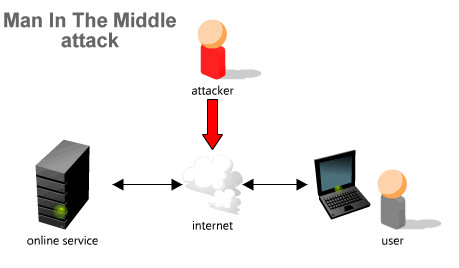
Eso no significa ni de lejos que hayan conseguido asaltar los servidores de esta empresa, no es esa la idea. Pero ellos podrian haber ejecutado algun tipo de ataque "Man in The Middle/Hombre en Medio" (MITM)


¿Porque y/o para que querria alguien ejecutar un ataque MITM?

Este es el punto más simple del post: para robar información sensible como pueden ser usuarios y contraseñas e incluso cuentas bancarias.


¿Que es un ataque MITM?


Vamos a suponer: Quiero ejecutar un ataque MITM entre un servidor de Google y el PC de un amigo.
Inicialmente necesetariamos algun programa o herramienta para "engañar" al PC de tu amigo (p.ej: Metasploit).
Cuando el acceda a www.google.com, realmente no estará accediendo a Google, el accederá a mi PC que estará camuflado como tal servidor mientras yo estoy conectado realmente al servidor de Google.

En la imagen superior, "Web Server" podria ser Google de nuestro ejemplo y "Victim" sería el PC de nuestro amigo.

En la imagen de la izquierda, la victima es "authorized user". El atacante dice al punto de acceso (AP) que él es la victima (el usuario autentico) y el atancante también le dice al usuario que él es el AP.

Te este modo, el atacante estará literalmente en el medio de la comunicación de datos.
Entonces, el usuario autentico pensará que está conectado directamente a la red corporativa pero el atacante estará revisando e incluso almacenando toda la información que transmita.


Entonces ¿Que es XSS?

XSS es un tipo de vulnerabilidad directamente relacionada con paginas y aplicaciones web que permiten al atacante introducir y obtener datos saltandose cualquier validación por parte del servidor.
De este tipo de vulnerabilidad pueden darse varios casos y tipos, veremos lo más sencillo.

A modo de resumen (si eres un hacker o experto en seguridad probablemente estas afirmaciones te producirán ardor de estomago, este blog siempre piensa en explicaciones sencillas para gente que no es experta)

- Si el hacker engaña al usuario remoto y usa sus datos para entrar en el servidor, es un ataque XSS no persistente.
- Si el hacker engaña al servidor y utiliza sus datos para conectarse con el cliente y obtener sus datos, es un ataque XSS persistente.

Para hacerse una idea del segundo tipo, una explicación gráfica:

Si ya quieres meterme más en el tema sobre XSS te remito aqui.
------------------------


Somos legión.
Siguiente post: "HOIC: new improved version of LOIC"

Popular Posts